Additively Manufactured Ceramic Catalysts for Chemical Processing
.webp)
Catalysts play a fundamental role in numerous chemical processes, accelerating reactions between gases or liquids to make operations more efficient, economical, and sustainable. However, a catalyst's performance depends heavily on the geometry of its carrier substrate, not just its active coating. At this critical intersection of material properties and design, additive manufacturing is opening up new engineering possibilities.
The Challenge: Balancing Surface Area, Fluid Flow, and Structural Stability
Catalyst substrates must simultaneously satisfy several demanding requirements. They need to maximize the surface area available for the active catalytic washcoat while maintaining optimal fluid dynamics to ensure uniform media flow through the reactor. Additionally, these components must withstand high process temperatures, chemically aggressive environments, and mechanical stresses.
While established carrier geometries each offer specific chemical engineering advantages for certain applications, engineers have historically faced manufacturing limitations when attempting to optimize fluid mixing, defined flow behavior, and mechanical strength at the same time. Additive manufacturing introduces a new approach, allowing these parameters to be tailored simultaneously without process-driven trade-offs.
Geometry as a Performance Driver
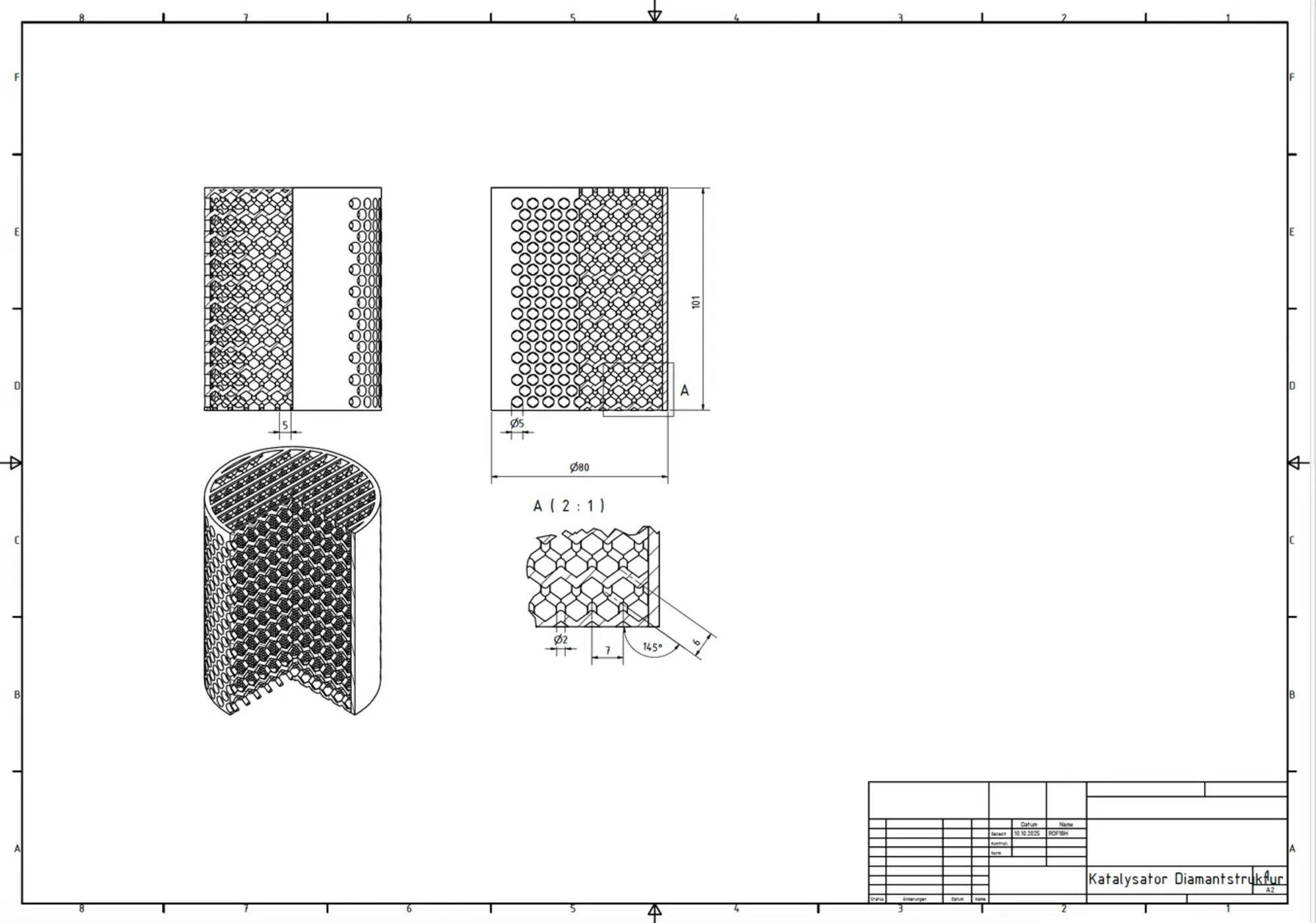
For this specific application, a periodic diamond structure (Periodic Open Cell Structure, or POCS) was utilized. The intricate struts mimic the crystalline bonding structure of a diamond lattice, creating a highly porous network. As gases or liquids pass through this structure, they come into direct contact with the active catalytic layer applied to the surface.
This specific geometry induces controlled, turbulent mixing of the reactants, as the medium is continuously redirected at 145-degree angles at each strut intersection. Surface area, porosity, and flow dynamics can be accurately specified and simulated using Computational Fluid Dynamics (CFD). Consequently, the substrate design can be tailored precisely to the exact kinetics of the respective process.
Why Advanced Ceramics?
Ceramic carrier structures have been standard in chemical processing for decades, with high-purity alumina (Al2O3) being one of the industry's benchmark materials. The Alumina material used here achieves a material purity of 99.99% and a relative density of 98.6% post-sintering. This technical ceramic offers exceptional thermal stability, chemical inertness against acidic or alkaline media, and high wear resistance. These properties make it ideal for supporting active coatings under demanding thermal and mechanical operating conditions. Directly printing the entire component from technical ceramic ensures robust, stable structures capable of long-term reliability under severe conditions.
Additive Manufacturing Enables Advanced Catalyst Structures
Production is carried out via LCD-based stereolithography using Low Force Display™ (LFD) technology. This process utilizes a high-resolution LCD mask for layer-by-layer area exposure, combined with significantly reduced peel forces during the separation cycle. This setup enables the precise and highly repeatable production of intricate, periodic lattice structures. Additive manufacturing grants extensive design freedom alongside the ability to consistently hit tight dimensional tolerances. This specific component achieves dimensional accuracies of under 200 µm, reliably meeting the client’s strict specification of a maximum 0.5% deviation from nominal dimensions.
Reliable Post-Processing and Thermal Control
The primary technical challenge when scaling the additive manufacturing of large, high-porosity ceramic geometries lies in controlling the downstream thermal processes. After printing, ceramic components undergo debinding and sintering. During these stages, thermal stresses and significant material shrinkage occur. Without precise process control, large yet delicate structures are highly susceptible to warping or micro-cracking.
As an industrial contract manufacturer, Sinto Advanced Ceramics standardizes the precise alignment of part design, slurry formulation, and thermal profiles across the entire production chain. This end-to-end process control is the only way to produce these complex lattice geometries repeatably and defect-free at scale. Industry professionals and technical visitors frequently note the exceptional quality achieved here, particularly regarding the combination of overall component size, fine diamond features, and crack-free ceramic execution.
Cost-Efficiency and Scalability in Series Production
The utilized LFD technology provides a highly cost-efficient pathway to industrial-grade ceramic additive manufacturing. Whenever production demands rise, additional capacity can be added flexibly by integrating modular printer units into our production floor.
For components of this volume, material utilization is a critical economic driver. The diamond structure couples high functional surface area with highly efficient material usage, establishing a firm foundation for viable commercial production. Because this manufacturing concept is built from the ground up for industrial series production, material properties and manufacturing parameters remain constant throughout the entire product lifecycle, minimizing scaling costs.
Technical Project Overview
- Application: Catalyst substrate for chemical processes
- Material: Alumina (Alumina, 99.99% Al2O3)
- Manufacturing Process: Low Force Display™ (LFD) Technology
- Dimensions: Diameter 80 mm, Height 101 mm
- Mass: 313 g (including solid outer shroud)
- Structural Specifications: Strut thickness 2 mm / Nominal pore size 5 mm
- Key Features: Periodic diamond structure, turbulent mixing via 145° strut orientation
From Catalyst Design to Industrial Series Production
This catalyst substrate serves as a prime example of the potential unlocked by pairing technical ceramics with additive manufacturing. The geometry was derived directly from the exact requirements of the chemical process. However, the project also highlights that successfully transitioning the printed "green" part into a fully dense, sintered ceramic component is where true industrial core competence lies. Only reproducible, defect-free manufacturing turns a promising design into a commercially viable catalyst substrate. For plant engineers and process developers, this opens up unprecedented design freedom, allowing surface area, fluid dynamics, and material performance to be optimized as one.