Scaling Ceramic Additive Manufacturing

Additive manufacturing (AM) for technical ceramics is often celebrated for its design freedom, zero tooling costs, and ability to create complex geometries. But successfully printing a one-off prototype is one thing. Scaling that prototype into a reliable, high-volume serial production run is an entirely different reality.
Many organizations hit a wall when transitioning to scale because they view ceramic 3D printing merely as a hardware capability. In truth, it is a complex thermodynamic process that requires deep manufacturing discipline. At Sinto Advanced Ceramics (operating as Bosch Advanced Ceramics within the Bosch Group until December 2025), we know that true scalability is built on a deep understanding of industrialization. Since 2018, we have been manufacturing technical ceramics in series. By combining 3D printing technologies with the Bosch Group's over 100 years of ceramic shaping and thermal processing expertise, we have turned the promise of scaled ceramic AM into a robust reality.
Mastering the End-to-End Process
The most common misconception in ceramic AM is that the process ends when the printer stops. In reality, the 3D-printed "green body" is just the entry point of the value chain. Because technical ceramics shrink in volume during the sintering phase, the key to dimensional accuracy and structural integrity lies in post-processing and thermal treatments. Scaling up successfully requires control over every single phase of the journey. We achieve this through:
- Strict quality control of every process step.
- Ongoing progress in increasing automation.
- A deep understanding of the possibilities and limitations of current technology.
- The development of our own exclusive processes.
This holistic approach guarantees consistent quality in terms of the density, dimensional accuracy, and mechanical strength of each part in a series.
Solving Real-World Industrial Challenges
Trust in manufacturing is built on proven track records rather than theoretical capabilities. Our production lines are specifically designed to handle high volumes, miniaturization, and complex functional integration across diverse industries.
Overcoming the Volume Challenge in Medical Technology
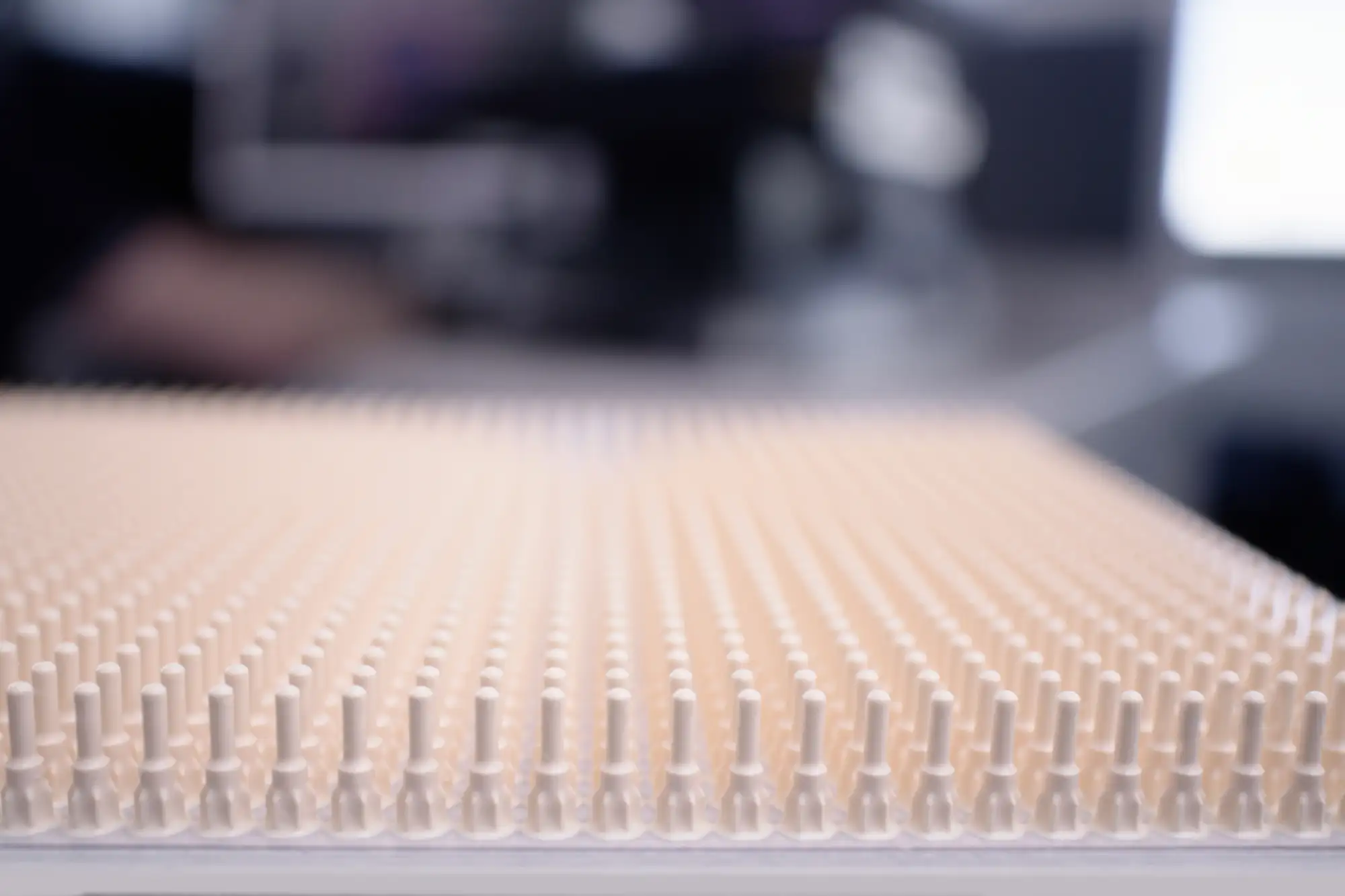
Producing microscopic parts with thin walls at high volumes is technically demanding. When tasked with creating a critical electrical insulating sleeve for a minimally invasive laparoscopic tool, we successfully print 1,400 parts in a single batch. We consistently achieve a wall thickness of 90 µm with tight tolerances of +/- 30 µm. Paired with our proprietary automated cleaning process—which safely removes excess slurry without damaging fragile green structures—we meet yearly demands of up to 50,000 units.

Mastering Complexity in Semiconductor Manufacturing
In semiconductor fabrication, components face aggressive plasma etching gases and high temperatures. A client approached us with a leak-prone, previously two-part gas injector. Leveraging the design freedom of AM, we manufactured a single-part component out of 99.8% high-purity alumina. The new design features three integrated internal channels feeding into 62 flow-optimized outlets with 0.2 mm walls. By printing this as a single unit, we eliminated joint interfaces, minimizing cleanroom risks and ensuring leak-free performance.
Delivering Consistency for Chemical Processing and Textiles
Whether we are printing a 3D diamond-lattice catalyst carrier for chemical reactors or creating high-volume components for the textile industry, repeatability is key.
- Catalyst Carrier: We printed a uniform, open-lattice structure from 99.99% pure alumina. This design optimizes fluid pathways and withstands harsh reactor environments far better than traditional coated foams.
- Textile Industry: We printed 444 identical, wear-resistant ceramic needles in a single print job. This demonstrates that our additive processes scale systematically, maintaining strict tolerances of +/- 0.05 mm across hundreds of parts simultaneously.
The Right Technology for Every Requirement
Because no single application is identical, we do not force a one-size-fits-all approach. We currently deploy three leading technologies: LCM, SLA, and LFD. This flexibility allows us to match the specific geometry, throughput, and target precision of your project to the ideal manufacturing method.
Combined with our robust portfolio of oxide ceramics—including Alumina, Zirconia, ATZ, and ZTA—we can manufacture components that offer electrical isolation, high fracture toughness, and chemical stability.
Partnering with Experts for Experts
To successfully scale ceramic additive manufacturing, true scalability requires an end-to-end industrial philosophy, deep material expertise, and rigorous quality assurance pipelines. At Sinto Advanced Ceramics we deliver reliable, scalable, and high-performance ceramic solutions that fit seamlessly into your industrial supply chain.
Are you ready to transition your technical ceramic applications from prototype to high-volume reality? Let’s discuss how our industrial mindset can scale your next innovation.